Song Sketch
Bittersweet Sixteen – Hum Toh Khelat Rahni – Ganga Maiyya Tohe Piyari Chadhaibo
A legend goes that once when James Thornton, an English/Irish songwriter was having a conversation with his wife, she asked him – do you still love me? And he answered – I still love you the way I did when you were sweet sixteen. This particular conversation inspired James Thornton to write – When I was sweet sixteen, in 1898. From then perhaps the phrase ‘sweet sixteen’ got prominence in songs and poems. We have the very famous – I’m sixteen, going on seventeen…from The Sound of Music as well.
In the Western culture, girls were officially introduced into society through events called balls. These balls were either hosted by the parents , if they were affluent or the parents waited for an invitation from the affluent families. This was an official announcement (almost), that the girl had come of age and was ready to mingle with the opposite gender with marriage in mind. The transition from childhood to young adulthood. The period where she starts to comprehend things around her and creates an awareness towards herself and the society. Just like Majrooh writes –
अजब है ये साल, समझ का है काल…
In Indian culture, though the girls were married off at a very young age of 4-5 earlier, she was sent to her in-laws’ house only after she turned sixteen. The tradition is called gauna, which indicated that the girl was officially ready to consummate the marriage. This fact became a celebrated motif for Indian literature and became a symbolical inspiration to the lyricists of Indian cinema to write numerous songs on sweet sixteen. Though most of the songs describe the first experience of love, just like Anand Bakshi’s –
सोलह बरस की बाली उमर को सलाम,
ए यार तेरी पहली नज़र को सलाम…..
There are songs which bring forth the other side of the situation. A situation where the girl has to bear the eyes, glances, provocations and judgements of the society, especially men, which caused an early trauma, making the age bittersweet sixteen.
In this list, Majrooh Sultanpuri writes –
राह चलूँ जो अकेले, तो लाखों अलबेले
पुकारे दिल ले ले, ओ नैन वालिये
तोड़ के अकल की डोरी, निकल पड़ी गोरी
काहे को चोरी-चोरी, दो नैन वालिये
ये सीधी-साधी चाल, हुई रे जंजाल
देखो मोहे लागा सोलवां साल…
Kaviraj Shailendra writes something similar in a Bhojpuri song.
हम तो खेलत रहनी, अम्माजी की गोदिया
करी गइले तबही, ब्याह रे बिदेसिया…
Ganga Maiyya Tohe Piyari Chadhaibo (1963), the first Bhojpuri film. It became a blockbuster and created history. Written by the veteran actor Nazir Hussain, the film had some known faces from the Hindi film industry for obvious reasons. It is said that this film was made on the behest of the then President, Dr. Rajendra Prasad.
Shailendra, Chitragupt, Lata Mangeshkar, Mohammed Rafi, Usha Mangeshkar. If one sees these names on the music label, one might think that the songs were from a Hindi film. But this is a music label from a Bhojpuri film.
One more name in the list made me stop and think and that name was Suman Kalyanpur. Which type of song it might be? And the song really came as a surprise. A ‘sort of nautanki’ song, picturised on none other than the gorgeous, Helen. If one is asked to make a list of Helen songs, Suman Kalyanpur might not be the popular choice. But this song has been done very beautifully and aesthetically.
हम तो खेलत रहनी, अम्माजी की गोदिया
करी गइले तबही, ब्याह रे, बिदेसिया
छवरे महीना कह के, गइल रे कलकतवा
बीत गइल रे बारह बरिस रे, बिदेसिया…..
अब तो लगल मोरा सोहरवा साल
लोगवा नजर लगावे ला
अब हम कैसे चले डगरिया
लोगवा नजर लगावे ला….
The song though looks like a nautanki, it is not. It is a refined example of Bidesiya, a Bhojpuri folk theatre genre, which combines dialogues, dance and recitation. Bidesiya was created by legendary Bhojpuri poet, Bhikhari Thakur. Artists associated with Nautanki, Bidesiya etc have always been looked down upon by the society, just as the Marathi Lavani artists. But these folk genres have so much to tell. They talk about the taboos of society, malpractices. They basically create awareness amongst the village folks in an entertaining and subtle manner.
Bidesiya’s subject is often deeply emotional, built around the voice of a woman whose husband had gone away to a distant land for work and hasn’t returned for years. Quite similar to Bhojpuri Purvi Geet which belong to the tradition of migration songs. The premise of such songs is, loneliness, memories, yearning and the burden of public judgement, from a woman’s point of view. Bidesiya and Purvi Geet are similar in nature, the only difference being, Bidesiya is always performed by the stage artists, on the stage.
In this song as well, Helen is performing it on stage and the main premise of the song is separation or ‘viraha’.
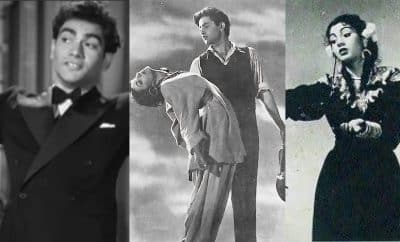
A Bidesiya troupe has arrived in the village and villagers are more than happy to watch it. Shyam (Asim Kumar), the son of a moneylender, has passed his graduation and the villagers including his father (played by the veteran Ramayan Tiwari), call it for celebration. The Bidesiya troupe is invited to perform. A woman-centric song where the voice should match the sweet sixteen age of the performer.
A loving smile, a serene face and a voice sweeter than honey. That’s what comes to our mind when we say Suman Kalyanpur. Her voice can be best described as, maybe, soft first rays of the sun or a beautiful bud blooming delicately, spreading its fragrance or soft drizzle of the rain. It was the gentle sincerity in her voice that set her apart from her contemporaries. The silken texture and it was surrounded by some sort of tranquility. She sang each word with emotional delicacy.
पूरब देश गइल मोरे सइया बैठ गइल बिसराय
रैन अन्हरिया टिप टिप बरसे रिस रिस जिया रिसाय
घर घर सब बतियावेला
अब हम कइसे रहीं नगरिया लोगवा नजर लगावेला
अब हम कइसे चली डगरिया लोगवा नजर लगावेला…..
The recurring line of the song – Logwa najar lagaale la – meaning people will cast an evil eye. But here it also means social scrutiny and gossip. People talk ill about her and her character. Her husband has gone to some distant land in the east and forgotten her. So they gossip about her. She is the vulnerable one here, without her husband and therefore an easy target. It is the people’s judgement that she is scared of. She’s bearing the burden of public judgement. She feels unsafe and constantly watched.
बाग़ बगइचा महुआ फुले, अमवा जब मोजराय
पापी पपीहा बोलिया मारे जियरा मोरा जराय
मन मोरा डूबत जाला ला
नदिया जैसे चढ़ी उमिरिया मन मोरा डूबत जाला ला
अब हम कइसे चली डगरिया लोगवा नजर लगावेला….
Kaviraj uses seasons to symbolise years going by. First it was the monsoon, now it is spring. It is here that she talks about her loneliness and yearning. She is in her prime years now and there’s no news of her husband returning home. She feels lonely without him.
The authentic Bidesiya performers use harmonium, flute, manjira and dholak and Chitragupt has retained those instruments to keep the original flavour of Bidesiya.
Sweet sixteen traditionally celebrates youth at its brightest. It is all a promise. Innocence, excitement and the feeling of life at its fullest. Bittersweet sixteen, however, suggests a different and an emotional landscape. It recognizes that growing up is a series of gains and losses. It is not just the newfound freedom but also the first awareness. Suman Kalyanpur, with her graceful femininity brings forth this sense of bittersweet emotions, in her voice. Her pronunciation and perfect diction of Bhojpuri words like – Ris ris jiya risaay or umiriya, seem to melt into those emotions. The emotions seem to emerge from the melody itself.
With his profound words, Kaviraj Shailendra suggests that pain is not simply a romantic separation. It is the social and emotional cost of migration, borne by the women left behind.